
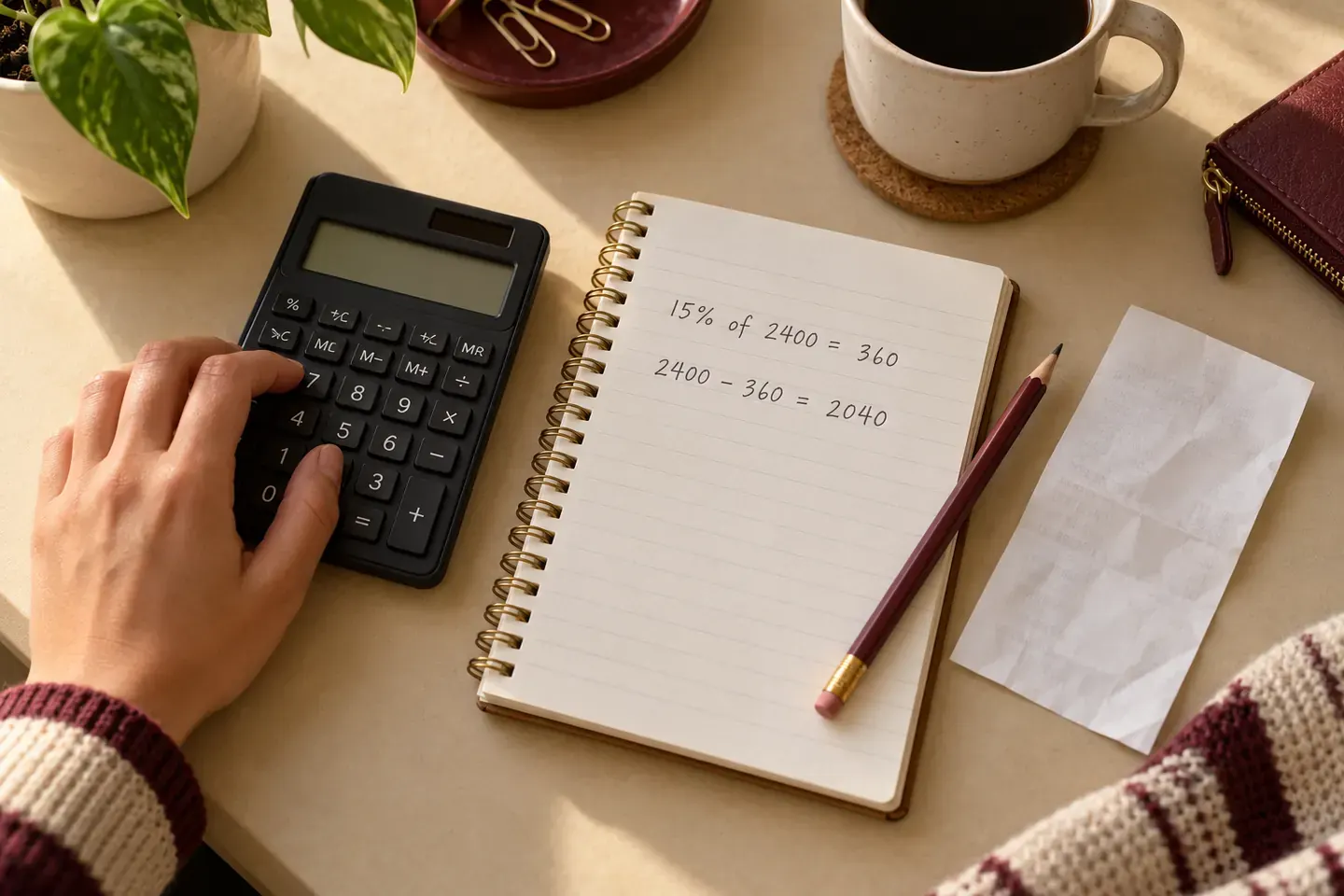
Seen a 15% discount and wondered how much you will actually save? The answer depends on what the question is asking. Finding 15% of a price is different from finding how much a price increased.
Here is how to calculate a percentage for the situations people run into most. If you want to check your working quickly, use the Serynix percentage calculator.
Three percentage questions, three formulas
| What are you trying to find? | Formula | Example |
|---|---|---|
| A percentage of a number | Number × percentage ÷ 100 | 15% of 2,400 = 360 |
| What percent one number is of another | Part ÷ whole × 100 | 36 out of 48 = 75% |
| Percentage change from an old value to a new one | (New value − old value) ÷ old value × 100 | 80 to 100 = 25% increase |
Pick the row that matches your question before putting numbers into a calculator. That one step prevents most percentage mix-ups.
How to find a percentage of a number
Use this when you want to know the amount represented by a percentage.
Formula: number × percentage ÷ 100
For example, what is 15% of 2,400?
- 2,400 × 15 = 36,000
- 36,000 ÷ 100 = 360
So 15% of 2,400 is 360.
This is also the first step in working out a discount. If an item costs 2,400 and has 15% off, the discount is 360. Subtract that from the original price: 2,400 − 360 = 2,040. The amount you save and the price you pay are two different answers.
How to work out what percentage one number is of another
Use this when the question sounds like “36 is what percent of 48?” Divide the part by the whole, then multiply by 100.
Formula: part ÷ whole × 100
Example: 36 ÷ 48 × 100 = 75%
You can use the same formula for a test score. If you got 42 marks out of 50, calculate 42 ÷ 50 × 100. Your score is 84%.
How to calculate a percentage increase or decrease
When a value changes, compare the difference with the original value. The original value is the one you divide by.
Formula: (new value − original value) ÷ original value × 100
Say a price goes from 80 to 100:
- Find the change: 100 − 80 = 20
- Divide by the original value: 20 ÷ 80 = 0.25
- Turn it into a percentage: 0.25 × 100 = 25% increase
If the value drops from 100 to 80, the decrease is 20 ÷ 100 × 100 = 20%. The increases and decreases are not the same percentage because the starting values are different.
If the original value is zero, this formula cannot give a percentage change because it would require dividing by zero. In that case, report the actual difference instead.
How to find the original price after a discount
This is where people often add the discount percentage back and get the wrong answer.
Suppose a price after a 20% discount is 800. After the discount, you are paying 80% of the original price. Write 80% as 0.8, then divide:
800 ÷ 0.8 = 1,000
The original price was 1,000. Adding 20% to 800 would give 960, which is not the original price because the 20% discount was taken from the higher starting price.
Use the right calculation, then check it
Before you calculate, ask yourself:
- Do I need the amount that a percentage represents?
- Am I finding what percentage one number is of a total?
- Am I comparing an old value with a new one?
- Do I know the final price but need to find the original?
Once you know which question you have, the formula is simple. For a quick result, enter the values in the Serynix percentage calculator, then check that the result answers the question you meant to ask.
Frequently asked questions
What is the easiest way to calculate a percentage?
For a percentage of a number, multiply the number by the percentage and divide by 100. For example, 15% of 2,400 is 360. Choose the right formula first: finding a share of a total and measuring a change answer different questions.
Why does a 20% increase not reverse a 20% discount?
The percentages use different starting amounts. A 20% discount takes 1,000 down to 800, but 20% of 800 is only 160. To recover the original price after that discount, divide the reduced price by 0.8 instead of adding 20%.
Can I calculate a percentage change from zero?
Not with the usual percentage-change formula, because it divides by the original value. Division by zero does not produce a usable percentage. Report the actual difference instead, such as an increase from zero to 50, and explain what the numbers measure.