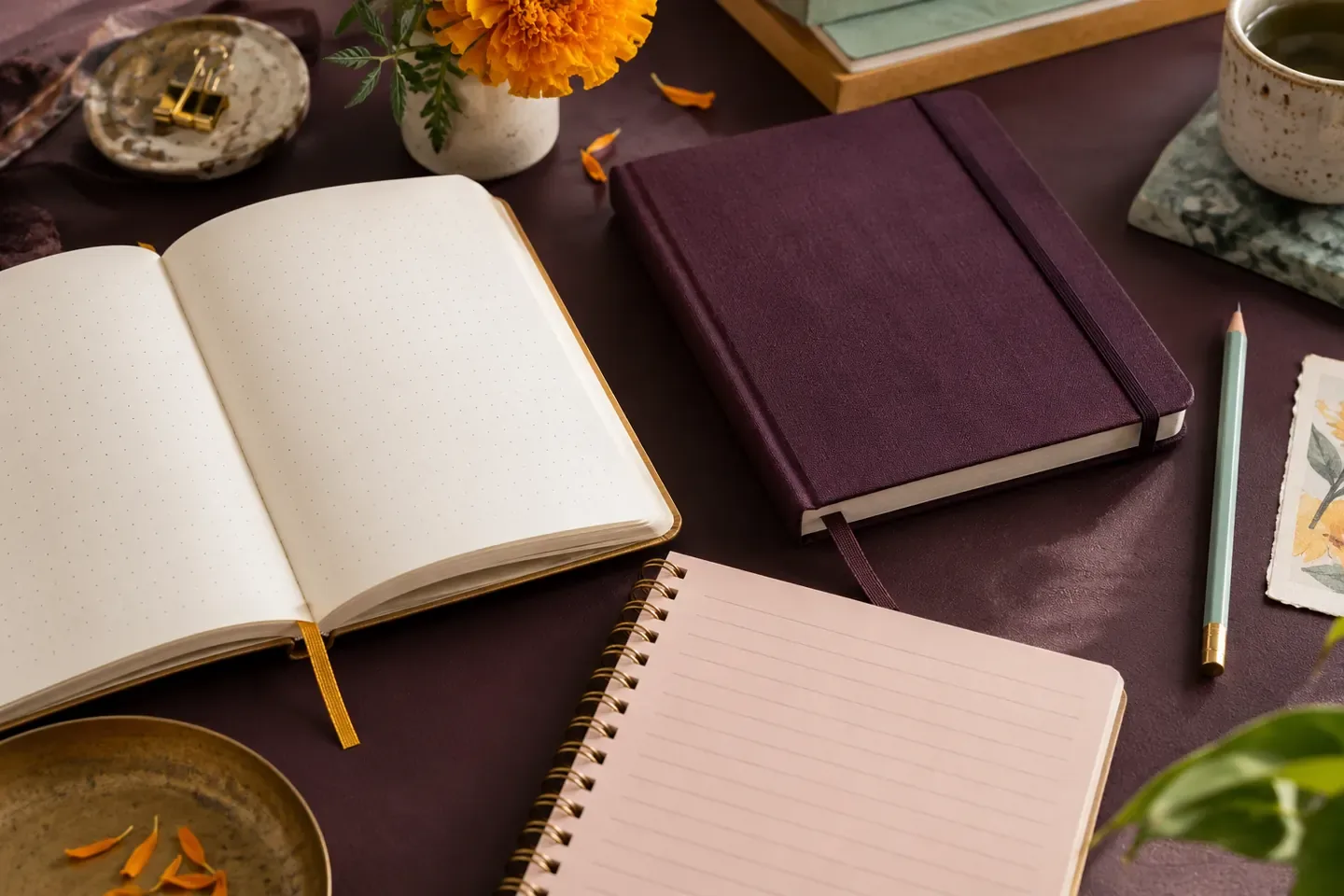
To choose a notebook, start with a page you have already written and the pen you normally use. Size, line spacing and binding affect daily use more than a “premium” label.
For ordinary notes, an A5 lined notebook is a reasonable starting point. If you draw diagrams, write large or need several columns, try a larger page. If you carry it every day, test whether it actually fits your bag.
Serynix has not tested individual notebook models for this guide. The examples below use published specifications and practical checks, not a product ranking or paid recommendation.
First decide what your pages need to do
Take a recent page and ask: do I write paragraphs, sketch relationships, calculate, plan or tear out notes for other people?
| Main use | Feature to check first | A quick test |
|---|---|---|
| Meetings or a journal | Comfortable line spacing | Write five normal lines without squeezing |
| Diagrams and study notes | Enough usable width | Copy one real diagram at a readable size |
| Lists while standing | Firm backing and portability | Hold it as you would use it |
| Sharing individual notes | Perforations or removable sheets | Inspect the tear line and remaining edge |
| Rearranging a project | Refillable or movable pages | Check matching refill availability |
Choose for the job you do most often. A notebook that handles every possible activity may be bulkier than the one you will actually use.
Size names are a starting point, not a fit guarantee
A5 paper is commonly 148 × 210 mm; A4 is 210 × 297 mm. Folding an A4 sheet in half gives a useful A5 writing-area trial. A6, at 105 × 148 mm, suits short notes but gives you much less width.
Be particularly careful with B5 and Semi-B5 labels. Japanese JIS B5 and other B5 conventions differ. For a concrete example, KOKUYO lists this Semi-B5 notebook (opens in a new tab) at 179 × 252 mm, with 30 sheets per book.
For a fitted cover, sleeve or refill system, compare the actual millimetres and thickness. A coil or cover can protrude beyond the page dimensions. Check the finished notebook size rather than buying a cover from the paper-size name alone.
Lined, dotted, grid or blank?
Lined paper is straightforward for sentences. Dots give light guidance for mixed layouts, while square grids help align figures and diagrams. Blank paper gives maximum freedom but fewer alignment cues.
Look at an actual interior photo. If your current ruling makes you skip every other line, try wider spacing. Very pale dots may disappear under your room lighting; heavy grids may interfere with scanning or photographing notes.
You do not need a complicated page system to justify buying dots. Equally, there is little reason to pay more for an elaborate planner layout if you repeatedly ignore its boxes.
GSM cannot tell you everything about ink
GSM means grams per square metre, a measure of mass for a given area. It does not directly measure thickness, ink resistance or drying speed.
Distinguish these problems:
- Ghosting: writing is visible through the sheet.
- Bleed-through: ink reaches the reverse side.
- Feathering: ink spreads sideways around the letters.
- Smudging: ink transfers before it dries or when rubbed.
A higher GSM number alone does not guarantee a better result with your pen. Hobonichi's paper guidance (opens in a new tab) notes that pen, ink, amount of ink and writing conditions affect drying and appearance, and recommends testing on a less visible page.
If the shop provides a sample or gives permission, write your normal sentence, a filled-in mark and a quick underline. Let the ink dry as you normally would, then inspect both sides. Use a page test or credible pen-specific review when buying online. Paint and alcohol markers need their own suitable paper; do not assume a writing notebook will handle them.
Test the binding with your writing hand
Open a display copy near the beginning, middle and end. Rest your hand where it would normally sit. Check whether you can reach the inside edge without forcing the book flat.
A side coil may fold back conveniently but press into your hand. A top-bound pad avoids that side obstruction. A sewn or glued book may look tidy while still resisting opening; the binding name alone does not establish how comfortably it lies flat.
For loose or refillable systems, check the cost and availability of the exact refill format. A cheap cover with hard-to-find refills can become an expensive dead end.
Compare usable pages, not just the cover price
One sheet has two sides, so 80 sheets normally gives 160 pages. Sellers sometimes use “pages” and “sheets” inconsistently; verify the count.
Here is an original comparison:
| Notebook | Price | Writing sides you can comfortably use | Cost per usable side |
|---|---|---|---|
| A | £6 | 160 | 3.75p |
| B | £5 | 80, because you avoid the reverse | 6.25p |
These are illustrative prices, not current offers. Notebook A costs more upfront but less per usable side in this example. If you dislike its weight and leave it at home, that calculation stops being useful.
Before ordering, check the seller, actual dimensions, interior pictures and return terms. The FTC's shopping guidance (opens in a new tab) is useful for evaluating online sellers and keeping purchase records.
Your three-priority buying note
Write this before browsing:
I use my notebook for ___. My pen is ___. My three essentials are ___, ___ and ___. My maximum finished size is ___. My budget is ___.
That is enough structure to choose a notebook without researching every brand. Once you have it, start with ordinary notes. Our guide to turning notes into useful ideas can help you make the pages worth keeping.