If you work for a wage or salary in Australia, you have probably heard about the instant tax deduction: up to $1,000 off your taxable income for work-related expenses, with no receipts needed. It sounds simple, and mostly it is. But a few details can catch people out, especially when you also claim your own expenses.
This guide explains what the instant tax deduction is, who qualifies, how it interacts with the expenses you claim yourself, and what is worth doing now. One timing point first: it is not available for the tax return most people are lodging at the moment (2025-26). It first applies in your 2026-27 return.
What the instant tax deduction actually is
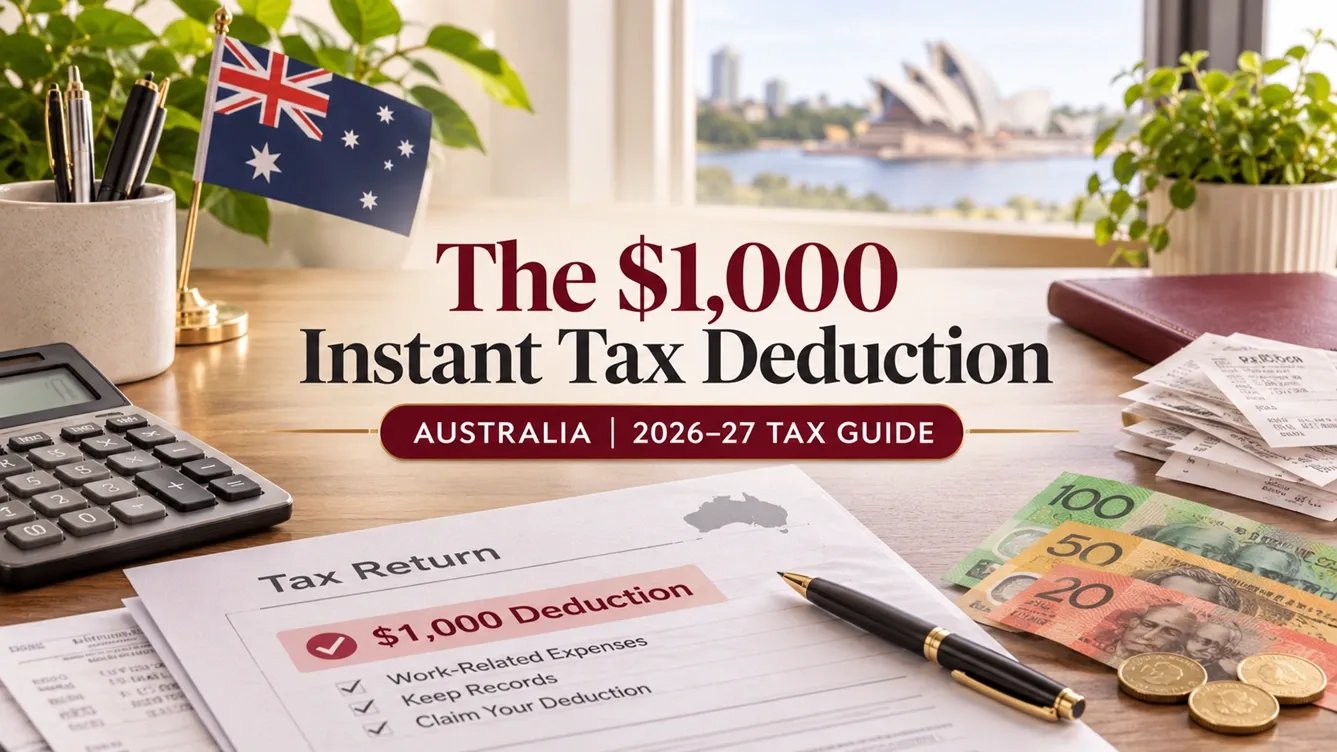
The ATO’s official name for the instant tax deduction is the standard deduction for work-related expenses. From the 2026-27 income year, eligible taxpayers are entitled to up to $1,000 without needing to have spent the money or kept records.
Three features are worth holding onto:
- It is automatic. If you are eligible, the ATO applies it in your tax return based on the information in the return. You do not need to claim it.
- It reduces your taxable income. It is not a tax offset or a rebate, so it does not hand you $1,000.
- It can be reduced. Any work-related expenses you claim that the standard deduction covers reduce it, dollar for dollar.
The 2026-27 income year runs from 1 July 2026 to 30 June 2027. You will see the deduction when you lodge that year’s return, which means from July 2027.
Who is eligible
You are eligible for the standard deduction if you:
- are an individual,
- are an Australian resident for tax purposes, and
- earn what the ATO calls assessable labour income.
Assessable labour income includes salary and wages, director fees and office holder payments, payments to religious practitioners, return-to-work payments, termination and retirement payments, and parental leave pay. If you only earn other types of income, such as dividends or business income, the standard deduction does not apply.
Your maximum is the lower of $1,000 or your total assessable labour income. The ATO gives a neat example: Simon earns $400 from casual work and receives $40,000 in dividends, interest and other investment income. His total income is $40,400, but his maximum standard deduction is $400, because only his labour income counts.
What is $1,000 actually worth to you?
A deduction lowers the income you are taxed on, so the saving depends on your tax rate. If your marginal rate were 30 percent, a $1,000 deduction would reduce your tax by about $300. At a lower rate it is less, at a higher rate it is more. You can find your own rates in the ATO’s tax rate tables, and the Serynix percentage calculator will do the sum once you know your rate.
So it is a useful trim to your tax, not a $1,000 payment. That distinction matters when you hear it described as a “$1,000 refund”, which it is not.
Should you claim your own work expenses as well?
This is the part that surprises people. The standard deduction is reduced dollar for dollar by the work-related expenses you claim that it covers. So claiming a small amount of your own expenses does not add anything on top. It just uses up part of the automatic $1,000, and then you need records to support the claim.
The ATO’s examples show it clearly:
| Situation | What you claim yourself | Standard deduction you end up with | Total deduction |
|---|---|---|---|
| Claim nothing | $0 | $1,000 | $1,000 |
| Yui claims $550 of work expenses | $550 | $450 | $1,000 |
| Marco claims $3,500 of work expenses | $3,500 | Nil | $3,500 |
Yui earns wages and had $550 of covered expenses: working from home, a training course and client travel. Either way her total deduction is $1,000. The ATO notes that it is easier for her not to claim the $550, because she keeps the full standard deduction and does not need records for those costs. Marco, on the other hand, spent $3,500, so he chooses to claim all of it with written evidence and receives no standard deduction at all, because his claim is above $1,000.
A simple rule of thumb follows from this:
- Eligible covered expenses below your own maximum: itemising them generally does not increase the combined covered deduction.
- Eligible covered expenses above your own maximum: check the itemised claim and keep the required evidence for every eligible cost you claim.
- Close to $1,000: be honest about whether the extra paperwork is worth a small difference. If your covered expenses came to $1,200, claiming them would give you a $1,200 deduction instead of $1,000, but you would need records for every item.
What reduces the deduction, and what does not
The ATO lists the kinds of expenses that reduce the standard deduction if you claim them:
- expenses related to earning labour income, such as stationery, tolls, travel allowance expenses, uniforms, laundry and working from home costs,
- car expenses related to earning labour income,
- transport between two or more separate workplaces (as long as none is your home),
- balancing adjustment deductions on assets used to earn labour income, and
- COVID-19 test expenses.
Some costs do not reduce it, and you still claim them in your return with the right records: union fees and memberships of trade, business or professional associations. The same goes for other deductions such as gifts and donations, investment and rental property deductions, the cost of managing your tax affairs, personal super contributions, and income protection or sickness and accident insurance premiums. In Yui’s example, her $50 donation and $175 tax agent fee are claimed as usual and do not touch the standard deduction.
Record-keeping changes that apply to everyone
A few related changes start from 1 July 2026 and apply regardless of whether you qualify for the standard deduction:
- The $300 total work expense exception for record-keeping no longer applies.
- The $150 laundry expense limit exception no longer applies.
- The award transport expense exemption no longer applies.
In plain terms, if you choose to claim more than your maximum standard deduction, you must have written evidence, such as a receipt, for all the work-related expenses you claim in your 2026-27 return and later. For laundry, the ATO says it will accept $1 per load if you only wash work clothes, and 50 cents per load if you mix in other clothes.
There is also a change for equipment. From 2026-27, you cannot add a depreciating asset to a low-value pool if you expected to use it mainly to earn labour income. You can still claim its decline in value, but that claim reduces your standard deduction.
For the full rules on what to keep, see the ATO’s page on records you need to keep.
What to do now
There is nothing to do for the 2025-26 tax return, because the standard deduction does not apply to it. For 2026-27, a few small habits will make life easier:
- Keep your receipts anyway. The ATO says it is not necessary if you expect your covered expenses to stay under the standard deduction, but it is still a good idea, because unexpected costs can push you over.
- Keep the union and association fee statements. They are claimed separately and still need records.
- Add up your eligible covered expenses at the end of the year. Compare the total with your own maximum standard deduction, which may be less than $1,000.
- Remember your income type. If you are a sole trader or earn income through a digital platform, your business expenses are handled separately, and only labour income counts toward the standard deduction.
- Check the ATO page before you lodge. The ATO’s detailed guidance on the standard deduction was still supported by a draft ruling when this guide was checked. Details can be refined, so read the current version on the ATO’s standard deduction page.
A small check before you decide
Write down these four figures: assessable labour income, your maximum standard deduction, eligible expenses in the covered categories, and separately claimable deductions.
For example, if your eligible maximum is $400, an expense total below $1,000 is not automatically below your maximum. Use $400 in your comparison. This follows from the income cap; it is not a separate allowance.
Keep employer reimbursements separate too. A repayment from an employer is not an invitation to claim the same cost again. If an expense mixes work, business and private use, ask which portion and rule apply before putting a total into the return.
The ATO?s standard-deduction guidance (opens in a new tab) is the place to confirm the current categories. The New Zealand guide covers a different system, so do not carry these Australian amounts into an NZ employee return.
The short version
For most employees with modest costs, the instant tax deduction means one less pile of receipts to chase. For people with large work expenses, it changes little, because itemising still wins. The only real trap is claiming a small amount of your own expenses and discovering it simply eats into the automatic $1,000.
This guide reflects ATO guidance checked on 14 November 2026. It is general information, not tax advice, so confirm your situation with the ATO or a registered tax agent.