
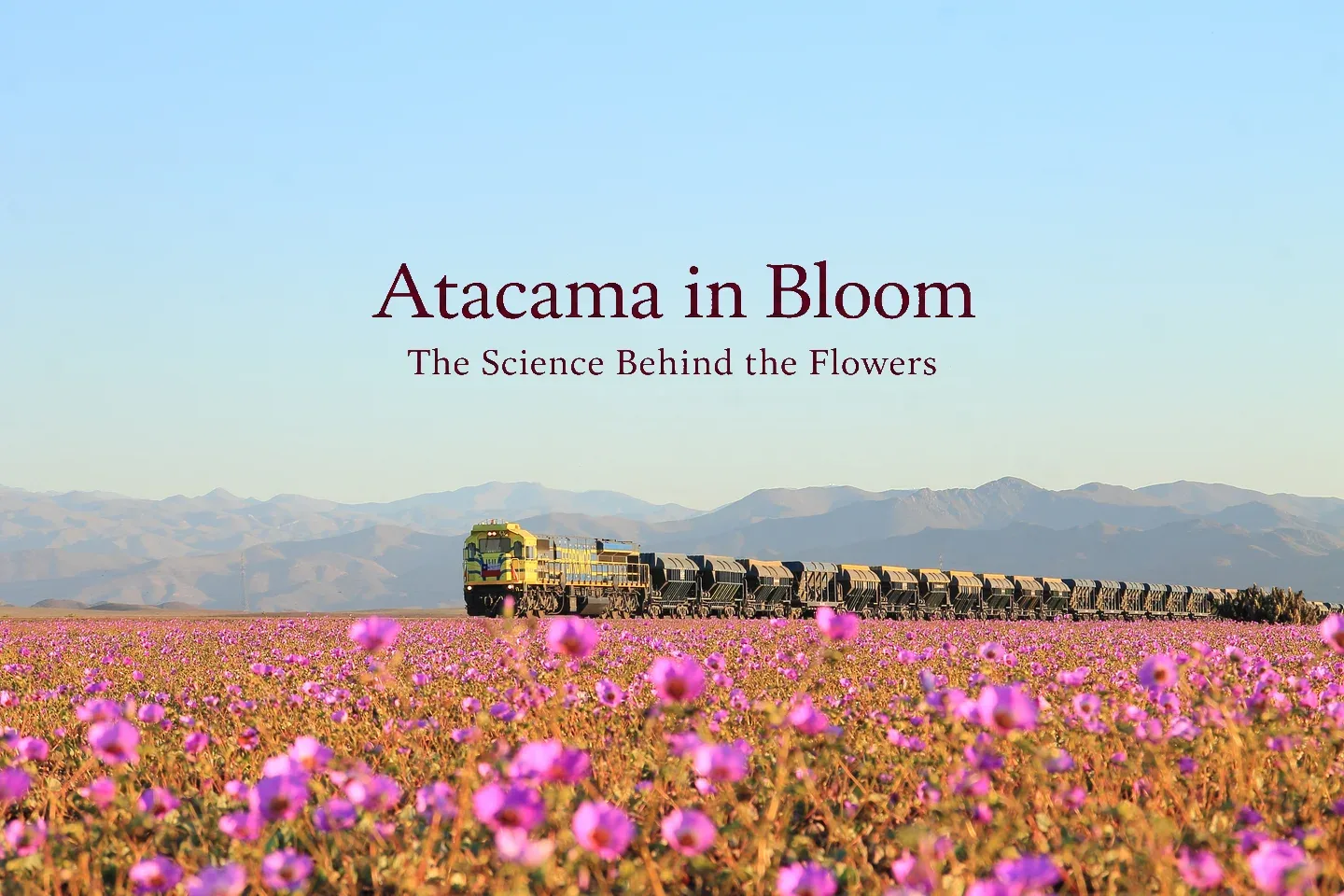
The Atacama Desert turned into a sea of flowers in 2026 because unusual winter rainfall created conditions for dormant seeds and underground plant parts to grow. The colour came from plants adapted to survive long dry periods, waiting for a suitable opportunity to emerge.
It is a wonderful change to picture: rocky ground and muted hills suddenly carrying patches of pink, purple, yellow and white. In Chile, the phenomenon is called desierto florido, or flowering desert. The apparent surprise above ground has a much longer history below it.
CONAF's 2026 explanation (opens in a new tab) describes a spring emergence of more than 200 species of annual plants and geophytes following unusual winter rain in the coastal Atacama region. That number describes the phenomenon's diversity, rather than a promise that every viewpoint contains every species.
Why is the Atacama normally so dry?
It sits where several barriers to rain overlap. The European Southern Observatory explains (opens in a new tab) that mountains limit incoming clouds, the cold Humboldt Current helps create a coastal inversion that discourages rain-cloud formation, and high pressure over the southeastern Pacific helps maintain dry conditions.
An inversion is a layer where the usual temperature pattern is reversed, restricting vertical air movement. High pressure favours sinking air, which warms as it descends and discourages cloud formation. The surrounding mountains matter too: moisture falling on one side does not necessarily reach the other. Together, these conditions help explain why a place beside an ocean can receive so little rain.
Coastal slopes, inland plains and high mountains still have different conditions. A story about flowering near Copiapó describes a particular part of this varied landscape.
What happened during the 2026 season?
The Atacama Regional Government's 1 October account (opens in a new tab) reported early bulb flowers in the second half of August and larger flowering areas from the first half of September, following the year's intense rains.
Its technical outlook placed the period of greatest diversity and abundance around mid-October, with some species potentially continuing into the second half of November. That was a seasonal projection, not a guarantee for every location or a live flower map.
The announcement also cited a projected activation area of approximately 17,667 square kilometres, about 23% of the Atacama administrative region. “Activation area” should not be read as a measured, uninterrupted carpet of flowers. The distinction matters when an impressive regional figure becomes a caption on a single photograph.
This article was checked on 28 November 2026. The seasonal outlook does not establish that a particular site is still flowering today.
There is also direct evidence of the changing display. NASA's 19 November account (opens in a new tab) compares September and October satellite images with researchers' ground photographs. White-flowered areas earlier in the season gave way to red-purple blooms in some locations.
Where were the plants during the dry years?
There are two useful survival strategies to understand.
Annual plants can wait as seeds. A landscape with few visible flowers can still hold the next generation below its surface. The Environment Ministry's biodiversity profile (opens in a new tab) describes seeds, bulbs and rhizomes emerging from dormancy when suitable rainfall conditions occur.
Geophytes persist through underground structures. CONAF describes plant parts such as bulbs, tubers and rhizomes that allow plants to remain below ground during dry periods. A bulb is part of a plant; it is different from a seed that must germinate into a new one.
Think of the landscape as holding several kinds of waiting life. After favourable conditions arrive, they do not all begin in the same way or follow precisely the same timetable.
The difference matters after flowering too. Annual plants complete their life cycle and leave seeds for another opportunity. Plants with bulbs or other persistent underground parts have a different way of surviving between favourable seasons. A field can lose its visible colour while still holding the means for a later bloom.
That makes the end of flowering part of the story, rather than the point when the landscape stops mattering. CONAF's park guidance (opens in a new tab) explains that taking a flower reduces seed production for future flowering. Protecting what comes after the photograph helps preserve the next generation.
Why did the rain make such a difference?
Water availability changes the opportunity to grow, but the timing and distribution matter too. The ministry's Atacama profile highlights rainfall spread across winter events, rather than treating one large downpour as a complete explanation.
NASA's explanation (opens in a new tab) connects the wet winter to a strengthening El Niño. Changes in Pacific pressure patterns shifted the Southern Hemisphere storm track towards the equator, helping storms reach the region. That explains part of the weather background; a climate pattern's name alone cannot predict where flowers will open on a future date.
What made the landscape so colourful?
The plants were not all producing the same flower. NASA's field and satellite comparisons distinguish two especially visible groups:
| Common name | Plant group | Appearance in the reported 2026 observations |
|---|---|---|
| Suspiros | Nolana | White flowers over green hillsides |
| Pata de guanaco | Cistanthe | Extensive red-purple flowering |
Those are plant groups, not a claim that every white or purple flower can be identified from a distant photograph. For someone watching the season unfold, the useful point is that different plants reach flowering at different times. Two photographs from the same hillside weeks apart can both be accurate, even when the colours look completely different.
Did the whole Atacama Desert bloom?
The name can make it sound as though an entire desert changed colour at once. The official location guidance describes particular flowering areas.
Chile Travel's 2026 overview (opens in a new tab) identifies places in the Atacama region including Huasco, Freirina, Vallenar, Caldera and Copiapó. It also names Llanos de Challe National Park and Desierto Florido National Park among places associated with the phenomenon. Rainfall and local conditions affect the distribution.
The broad view and the close view tell different stories: a hillside may show extensive colour while a nearby patch is sparse. Neither should be used alone to calculate the season's total coverage.
Enjoying the display without disturbing it
CONAF asks visitors to remain on established roads and marked paths, leave flowers, seeds and bulbs in place, and keep pets away. A close photograph should not require stepping into the plants.
There is also a way to contribute beyond sharing a scenic picture. The Environment Ministry's 2026 iNaturalist campaign (opens in a new tab) invites observations of the season's biodiversity. Follow the project's recording instructions and avoid disturbing organisms to obtain a photograph.
Keep the capture date and location with pictures you share: an upload date can be much later. The cover here is a real 26 September 2015 photograph illustrating the recurring bloom. Photo: EL GUILLE! (Guillermo Andre) (opens in a new tab), via Wikimedia Commons (opens in a new tab), CC BY 2.0 (opens in a new tab). It has been resized with title text added and does not document the 2026 season.
The Atacama Desert's flowers reveal how much life a quiet-looking landscape can hold. The rain makes that life visible for a time. Looking carefully, keeping the date and place with a photograph, and leaving the plants where they grow helps preserve both the story and the landscape.
Frequently asked questions
Does the flowering desert happen every year?
No fixed annual display is guaranteed. Chile Travel describes a combination of suitable rainfall and cold conditions (opens in a new tab) that enables flowering. The term “annual plant” describes a plant's life cycle, not a promise that the desert blooms every calendar year. The distribution of rain also means one area may flower while another stays sparse.
Should I book a trip to San Pedro de Atacama to see these flower fields?
San Pedro de Atacama (opens in a new tab) is farther north, in the Antofagasta region. The flower locations discussed here are around Copiapó, Vallenar and Huasco in the Atacama region. CONAF places Desierto Florido National Park about 30 km south of Copiapó (opens in a new tab). Match your transport and accommodation to the specific flowering location, rather than assuming every Atacama tour visits it.
Does one big bloom prove the desert's climate is becoming wetter?
One season cannot establish that trend. NOAA distinguishes short-term weather from climate patterns measured over many years (opens in a new tab). To assess a lasting change, researchers need comparable rainfall and vegetation records across seasons, including the influence of El Niño. The 2026 display documents a striking response to favourable conditions; its size alone does not answer the long-term climate question.